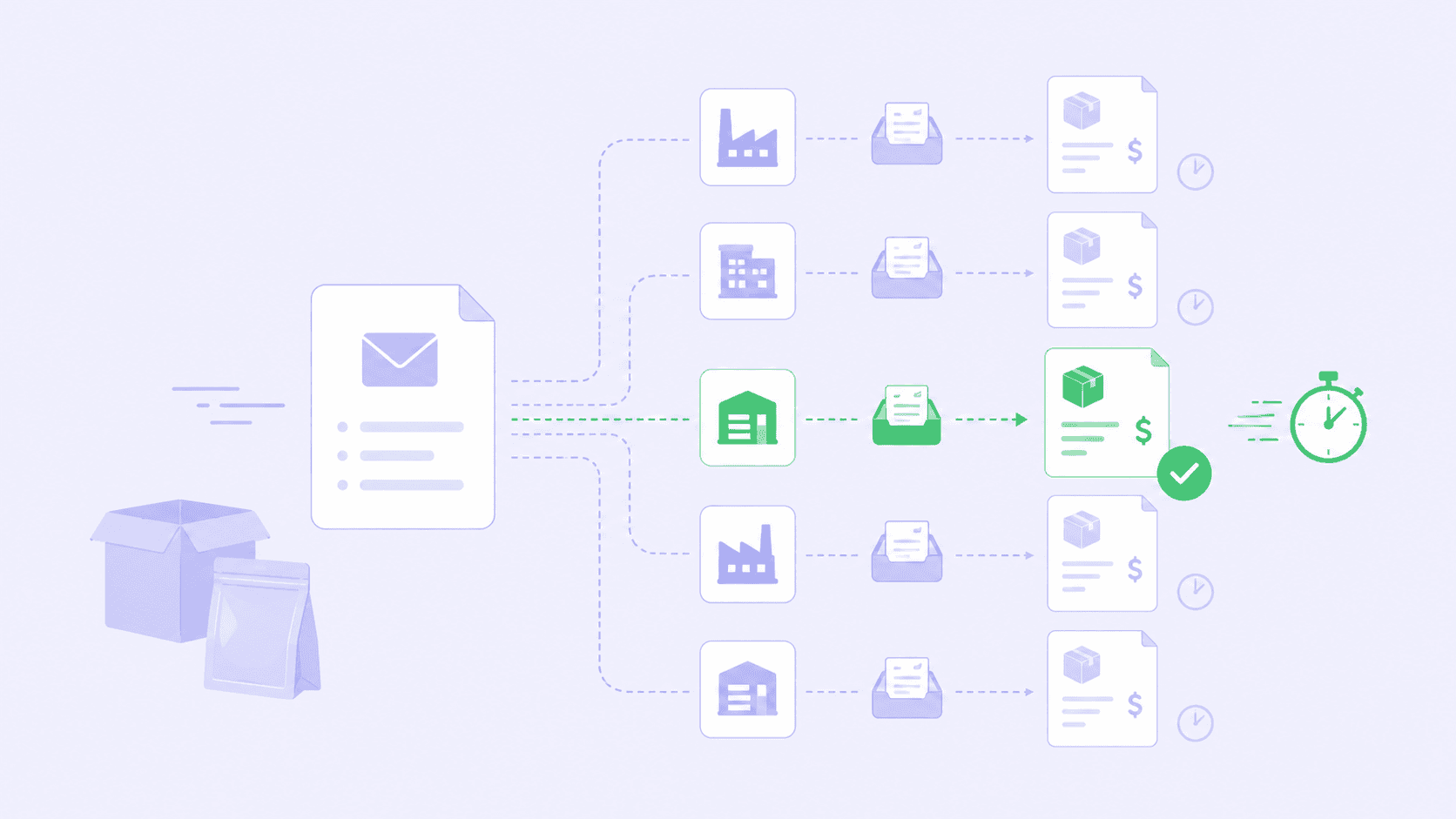
The packaging industry says the quiet part out loud. When a request for quote lands in five inboxes at once, the first responder usually secures the job.
That is the whole game now. Not the lowest price. Not the prettiest dieline. The first credible number in the buyer's inbox.
Why the First Quote Usually Wins
Because buyers stop shopping once they have a usable answer. Widely cited sales research puts the share of deals going to the first responder at between 35% and 50%, and buyers consistently report choosing the company that replied first.
The reason is human, not logical. A procurement manager sending an RFQ to five converters has a problem to solve today. The first solid quote anchors the decision. Everyone who replies after that is arguing against a number the buyer already holds.
Speed compounds at every step. Leads contacted within five minutes are far more likely to qualify than leads worked after thirty, and the odds drop with every minute that passes. The first quote does not just win more often. It wins the better deals.
All of that assumes your quote is being read at all. On larger accounts it may not be: buyers run a qualification screen before any price is compared, and being cut at that gate looks exactly like losing on price from the converter's side.
How Slow Packaging Quoting Is Today
Slow enough that most shops measure it in days, not hours. The average B2B response to an inbound lead runs to roughly 42 hours, nearly two business days, and most companies never reply inside the window that actually converts.
Packaging is worse than the average, and the reason is structural. A single RFQ travels through a dozen inboxes, three spreadsheets, and two PDF attachments before anyone replies. It arrives by email, sometimes by fax, sometimes as a photo of a handwritten purchase order sent over a messaging app. Someone reads it. Someone re-keys the specs. Someone waits for the one estimator who knows the cost model.
That estimator is the bottleneck, and the single point of failure. When they are on vacation, at a press check, or buried under twenty other quotes, the queue stops. The job that could have been quoted in minutes waits behind a person.
Two working days is the honest industry norm. It is what our own packaging operation used to tell customers to expect. The press, meanwhile, runs the actual job in minutes.
What Slowness Actually Costs
It costs deals you never knew you were close to winning. When your quote takes two days and a competitor's takes two hours, you do not lose on price. You lose before the buyer ever compares prices.
The cost shows up in three places:
-
Lost inbound. Requests scatter across email threads, shared inboxes, and chat apps. A meaningful share never gets a same-day reply, and some are never answered at all because nobody owned them.
-
The estimator chokepoint. Tying every quote to one expert caps throughput at one person's calendar. Volume cannot grow faster than they can type.
-
Anchored-out deals. Every hour you wait, the odds drop. By the time your quote lands, the buyer has framed the decision around someone else's number.
Why Speed Is Suddenly the Battleground
Because the macro pressure leaves nowhere else to compete. Three forces are squeezing converters at once, and all three reward whoever answers first.
Consolidation is thinning the field. Packaging M&A stayed active through 2025 as larger players absorbed smaller ones. Fewer, bigger competitors means losing a quote race more often means losing to scale.
Tariffs are eating margin. The 2025 doubling of steel and aluminium tariffs hit cans and metal closures directly, and higher raw-material costs flowed downstream across formats. When margins thin, you cannot buy the deal with price. You have to win it on service.
And response time is the cheapest service lever left. You cannot out-discount a tariff. You can answer faster than the shop across town. Speed is the one edge that does not cost margin.
Material cost is moving in the same direction and on its own schedule. Containerboard producers announced three price increases in five months in 2026, which puts a second clock on every quote: not just how fast you answer, but how long the answer stays priced correctly.
The Slowest Part of Packaging Is Not the Press
This is the thesis, and it reframes where the real constraint lives. Converters have spent decades optimising the plant floor: faster makereadies, tighter scheduling, less waste. Meanwhile the quote, the order, and the handoff still move at the speed of a busy inbox.
The bottleneck migrated. It is no longer the machine. It is the sales-and-operations layer in front of the machine: the reading, the re-keying, the waiting for one estimator. Fix that layer and you do not just reply faster. You reply faster and take on more volume without hiring more estimators.
How to Collapse Quote Time From Days to Minutes
You take the human bottleneck out of the path the request travels, without taking the human out of the decision. In practice, four moves, in order:
-
Read every channel. Email, fax, messaging apps, a photo of a handwritten purchase order. The request gets read however it arrives, so nothing waits for someone to notice it.
-
Extract the specs. Box type, dimensions, board grade, finish, print method, run length: all pulled out and structured automatically instead of retyped into a spreadsheet.
-
Price against a real cost model. Not a guess and not a generic calculator, but your own pricing rules and cost tables, applied in seconds, so the number is one a person can stand behind.
-
Route it into the pipeline. The draft quote lands in the workflow, assigned and tracked, ready for a human to review, adjust, and send.
In Packative One that path is quote automation sitting on top of the cost engine: read, extract, price, route, with a person approving before anything is sent.
Where This Stands Today
I want to be precise, because this industry is full of software that promises more than it ships.
Packative One runs real operations now. The platform handles the quote-to-production cycle on one packaging-native data model. The automation layer is a different story. It is rolling out step by step, and it is not finished.
Today the system assists. It reads and structures requests, drafts quotes against a cost model, and keeps the pipeline from leaking deals. A person still reviews and sends; every proposed write arrives as an approve-or-reject card. Full multi-channel autonomy, meaning every format read and every quote drafted end to end without a human in the loop, is the direction rather than a box we have checked.
We built it for our own operations first. We run packaging without owning a press, which means our quote desk lives or dies by exactly the problem described here. This is not a theory we are selling. It is what we needed ourselves, productised.
Câu Hỏi Thường Gặp
No. The system reads requests, structures specs, and drafts quotes against a real cost model, but a person reviews and sends. End-to-end autonomous quoting is the direction we are building, module by module, not a shipped feature today.
First published on the Packative blog in June 2026. Revised here with current product naming.